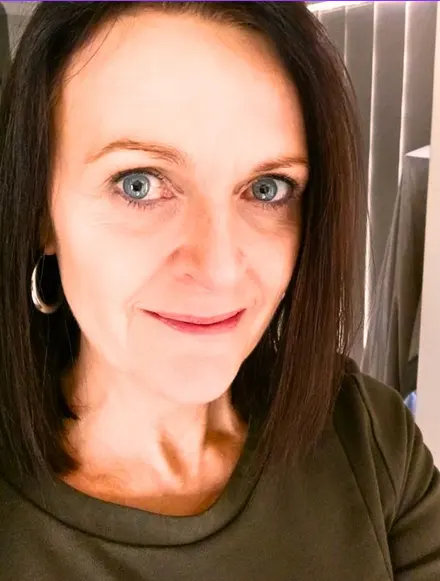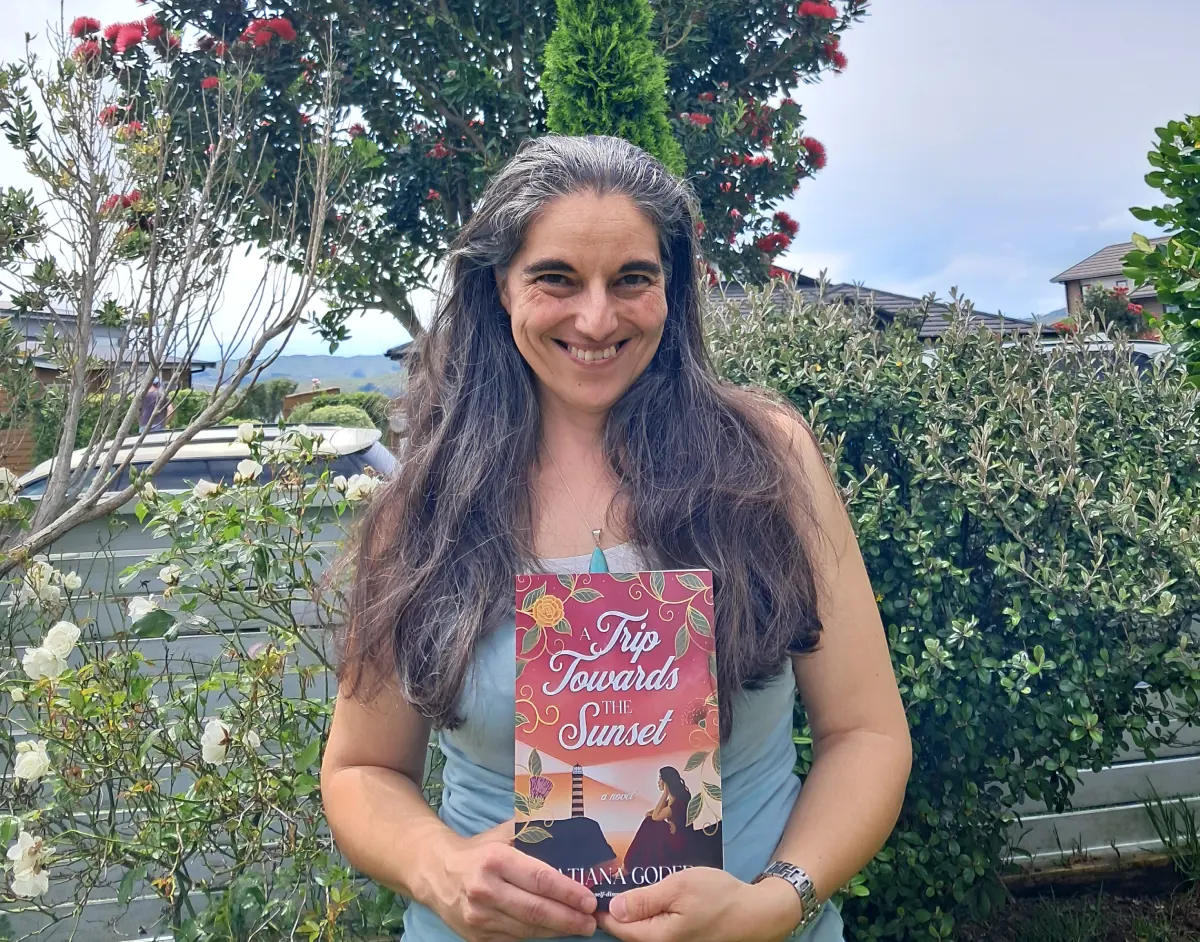
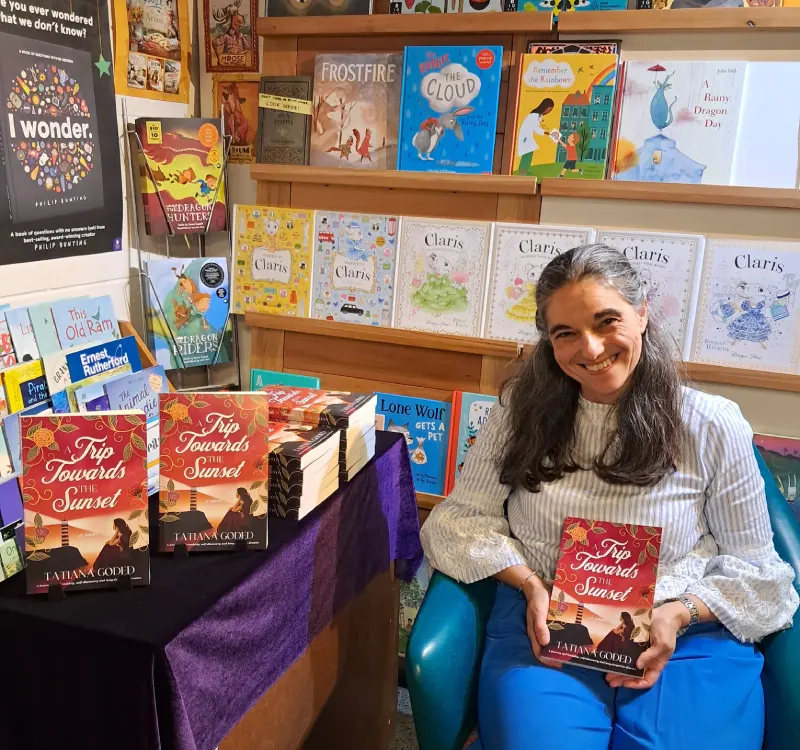
Tatiana Goded has a PhD in Seismology, three NZ Writers’ College courses under her belt, and a freshly published debut novel. A Trip Towards the Sunset came out in 2025. We sat down with Tatiana to talk about her writing process, the courses that changed everything, and her advice for anyone who’s ever wanted to write a book.
Can you tell us a bit about how your novel, A Trip Towards the Sunset came about?
I started writing A Trip Towards the Sunset in the Write a Novel Course at New Zealand Writers’ College. My teacher, Alex Smith, was amazing at helping me use the writing skills I’d gathered through two previous NZWC creative writing courses with Helen Brain (fantastic courses too), and helped me write a novella rather than the short stories I had been writing until then. I had tried to write my first novel on my own first, but it was so hard. There was a lot of planning to do in advance, and I didn’t have the knowledge to do it. So, when I started the Write a Novel Course, I already had a bit of material.
It was a difficult time in my life. I had recently separated from my partner, and I was struggling as a solo mum in a country far from my birth country, Spain. I had been living in New Zealand for ten years by then, but it was the first time I’d started feeling deep loneliness. It was a time of deep reflection in my life.
The course not only taught me how to write a novel, it also gave me the structure and discipline to keep writing. After the first two writing courses, I had stopped writing almost entirely. When I finished the Write a Novel Course, something changed inside me. I realised how important writing was in my life, and I decided to keep it, no matter what. Since then, I haven’t stopped writing.
After the course, I decided to turn the novella into a novel, and it grew from the initial 22,000 words to around 82,000. It gave me a beautiful project to focus on. The novella became the backbone of the novel, and I enriched it with chapters that delved deeper into each character, and I added a few secondary characters too.
Your three main characters, Cora, Irene and Sofia, each carry a different kind of restlessness. Which character is most like you? How did your own life experiences serve as inspiration?
The novel deeply reflects the period I was going through, with a focus on midlife women reconnecting with their true selves, solo parenting, friendship, loneliness and the struggle of feeling like you’re living two different lives when you live in a country different from the one you grew up in. All of this is woven into beautiful settings in New Zealand and Scotland mostly, making them a deep part of the book.
I guess Cora is most like me: Spanish, living in New Zealand, a solo mum and searching for meaning in her life. However, all three characters have something of me in them.
Irene lost her identity when she became a mum and fell into people-pleasing habits; she also has a deep need to recover a passion from her past.
Sofia is the sister who was left behind when Cora moved to New Zealand, the one with a deep sense of adventure that was cut short in her youth by a bad experience. Even though my life is very different from hers, I had a deep need to move overseas while my two sisters were already having their own overseas experiences.
I also share with Sofia a deep need for something else in her life, away from her monotonous way of living, and a wish to break free from the paths dictated by society.
Even though their life experiences differ, all three of them have a deep need for change, for things they left behind, and for a deeper connection with their inner world and their intuitive life. That’s something I share with all of them.
The novel moves between Golden Bay, Spain, Scotland and Germany. Was there a scene set somewhere you’d never actually been, and how did you create it?
No, I have been to all the places in the four countries. I wanted the scenery to be a deep part of the book, sharing an emotional connection with the characters. So I chose places that are special to me, where I’ve had beautiful experiences that are close to my heart. It was my way of digging deep into what those places meant to me and translating that into a connection with the characters that felt profound and real.
You’ve got a PhD in Seismology and a physics background. Did that scientist’s brain ever fight with the novelist’s brain, or did it sneak into the story in ways readers wouldn’t expect?
That’s an interesting question! I think I’ve always had two sides to my character: a deeply rational mind that deals with facts, and a deeply intuitive one that lets me flow. My novelist brain is different from my scientist brain. But what I found interesting while taking the NZWC writing courses was that writing, especially novel writing, was much more strategic and structural than I’d thought. So now I bring part of my scientist brain into my novelist brain to create the background, structure and foundations for the books I write, especially at the start, but also during the creative process.
That said, I love simply letting my writing flow. When I sit down to write, I never know where it’s going to take me, and I love that feeling. Sometimes I finish a piece and realise I’ve gone down a path I hadn’t envisioned. For me, that’s a magical part of writing. I then need to do some work to make sense of that piece within the context of the whole story, and that’s where the scientist brain comes in.
What’s a line or scene in A Trip Towards the Sunset that you struggled with most, and why?
More than a specific scene, I struggled with the chapter order. My book changes point-of-view character between Cora, Sofia and Irene, and even some secondary characters. It’s also set in different countries and moves back and forth in time. Getting the order right, so readers didn’t get lost or confused, was challenging. My book assessor was incredibly helpful with that. And it’s paid off. Quite a few people have told me how easy the book was to follow, which made me very proud, because I know how hard it was to get that balance right!
How did it come about that you decided to self-publish the book?
I wanted to keep control of my creative work and make sure what I wanted to convey stayed intact. I also read a few books about self-publishing that convinced me that was the path I wanted to take. However, I wanted a good-quality book: well written and properly presented. So I worked with wonderful people to help me. So, before going to the publisher, I already had a book I was proud of.
What’s something about the self-publishing/production process (cover, edits, distribution) that surprised you, good or bad?
Well, it was my first time publishing a book, and what surprised me most was the amount of work needed before publication. I reflected that in my acknowledgements section; I suddenly understood why most acknowledgements say it’s a team effort!
Being my debut novel, I thought getting it written would be the hardest part. In the end, it felt like the easiest. Proof of that: I’ve now written a second novel in just six months, and it’s still sitting there after being read by readers, because I feel overwhelmed by what comes next! But I’m finding the courage to take that next step. I think that, after the first one, I’ve become more fluent in the writing process and wiser in the decisions around publishing.
Looking back at the student on the Basics of Creative Writing Course versus the writer who just published a novel, what’s the biggest thing that changed, craft-wise?
Everything! Before taking that course, I was writing short stories or small pieces. I’d already won second prize in the Letras Latinas Short Story Competition, organised by Alac Inc and ‘Biblioteca de Letras Latinas’ in Auckland, so I knew I was doing a decent job.
Years before that, I’d taken an online writing course from a college in the UK, but I lacked the structure behind the craft: how to build characters, how to create plot, how a story needs a different pace depending on the scene, and the right balance of dialogue, description and action. Learning this on my NZWC courses really opened my eyes to how I needed to write. Over time, I learned to weave those structures in intuitively. For example, I now don’t usually consciously think about how much dialogue, description and action to add to a scene; it comes naturally, and I love that feeling.
Is there a piece of feedback from your courses that stung at the time but you now think really improved the book?
I remember my NZWC tutor Helen’s emphasis on using strong words, and how they ‘spoke more’ than long sentences. At first, I struggled to find strong verbs, adjectives or nouns in my writing. But once I managed it, I noticed how much it improved my ability to vividly describe what the characters were feeling and experiencing. That piece of advice considerably improved my writing.
I also remember being shocked that I shouldn’t add extravagant verbs after dialogue, such as ‘screamed’ or ‘burst’, and that ‘said’ was fine most of the time. I’d thought strong dialogue tags were needed to emphasise emotion.
From your hard-won experience, what advice would you give writers who are just starting out?
I’d say that writing is a craft in so many ways. It uses structure as well as flow, and that taking a writing course will considerably improve a writer’s skill. Even more importantly, a course will improve their self-confidence, helping them keep writing as part of their lives.
So many people love writing but feel ashamed of their work. First, because they think they’re not good enough, either from something someone told them in their youth, or from comparing themselves to others. Second, they don’t seem to find time for what they consider unimportant.
But if writing is a true passion, keeping it alive is life changing. It improves your wellbeing, your sense of happiness and your self-fulfilment. So, if writing is your passion, I recommend keeping it alive as much as you can and putting it near the top of your priority list.
I feel so strongly about this that, alongside my own writing, I now dedicate my life to helping midlife women reconnect with what I call their long-forgotten passions. I know well what it is to abandon a deep, creative passion, buried under ‘more important things’ such as career, family and responsibilities. Bringing writing back into my life, and making it stay, has been one of the most important shifts in my life, and it has considerably improved my sense of self-fulfilment. Even without publishing, keeping writing just for yourself is life changing.
Now that you’ve done it once, what would you do completely differently on your next novel?
First and foremost, I wouldn’t take so long over the first draft! Altogether, it took me about three years to write my first novel. The draft of the second was done in six months!
I felt my capacity for writing flow considerably increase after finishing my first book. So the most important change has been dedicating structured time to writing on a weekly, if not daily, basis.
Secondly, I’ve realised how important marketing is in getting people to know your book. I’m learning a fair amount about marketing strategy, and I’m planning to approach it very differently this time. I had a wonderful PR person to help me with marketing the first time, but I thought I could stay hands-off and leave it to her. Now I see that, especially for self-publishing (though traditional publishing needs it too), you need to put a lot of effort into marketing, and start early, even before you’ve finished writing the book. It’s not an easy stage, and it takes a lot of time, but overall, it’s worth the effort.
You can find A Trip Towards the Sunset here. Find out more about Tatiana on her author website here.